Training Smarter, Better Drivers
Have you ever wondered why driving looks so easy when someone else is doing it, but feels completely different when you’re the one behind the wheel?
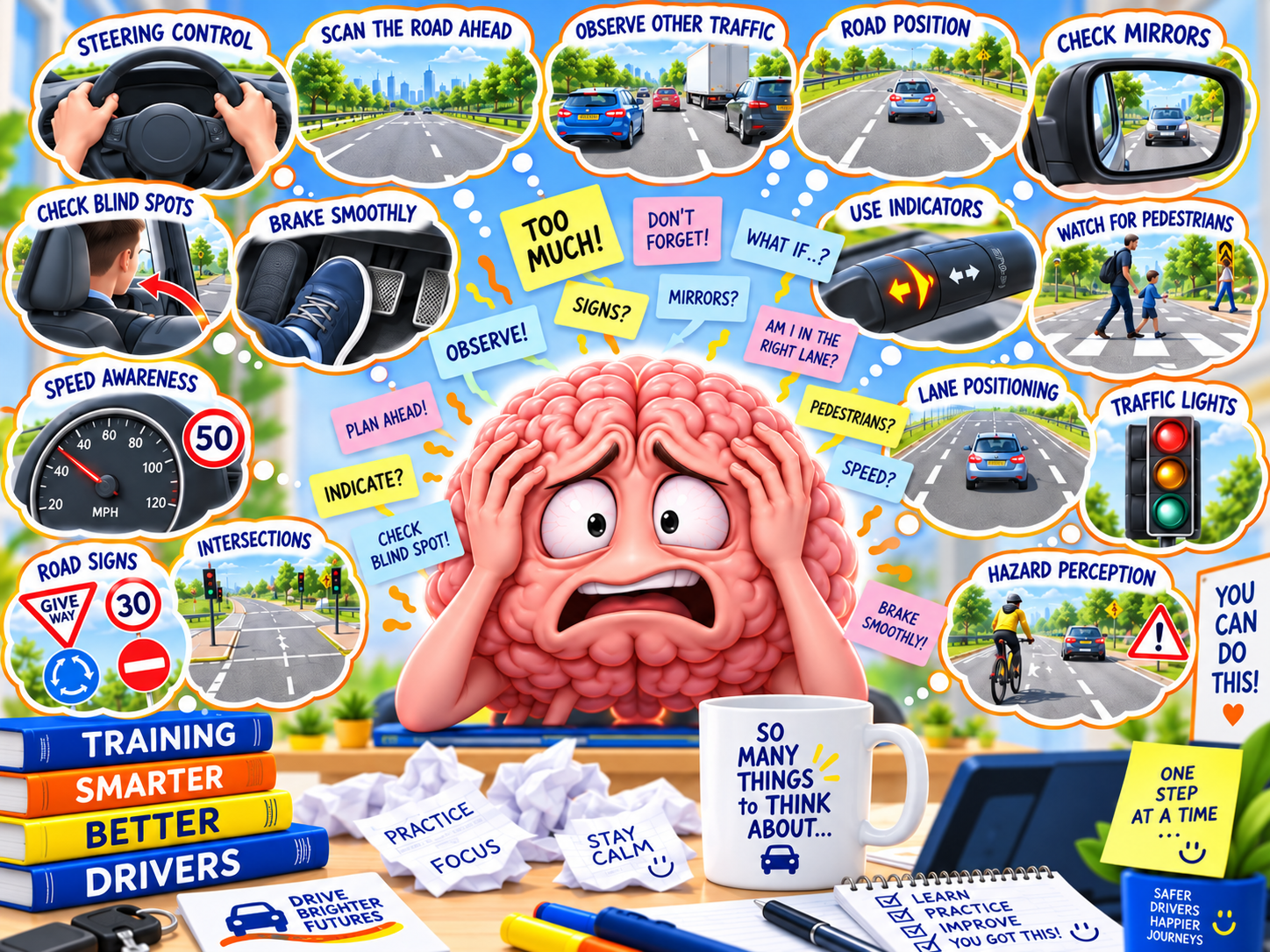
Suddenly you’re trying to steer, watch the road, check your mirrors, control your speed, listen to your instructor and work out what everyone else on the road is doing.
Meanwhile, an experienced driver seems to do all of this without thinking.
There is a reason for that.
Learning to drive involves your brain learning to manage several new skills at the same time. Research into novice drivers, vision and motor learning helps explain why those first hours behind the wheel require so much concentration — and why good practice matters.
Why Does Driving Feel So Hard at First?
Think about everything a new learner may be trying to manage:
An experienced driver has practiced these things thousands of times. A beginner hasn’t.
This means a learner has to consciously think about tasks that an experienced driver performs almost automatically.
Research into motor learning shows that when we develop a new physical skill, our brain has to get better at connecting what we see with the movements we need to make (Kim et al., 2024).
Knowing what you’re supposed to do and being able to do it smoothly are two very different things.
Why Does Steering Take So Much Practice?
Steering is a perfect example.
From the passenger seat, it looks simple. Turn the wheel and the car changes direction.
For a learner, there’s much more happening.
You have to work out where to look, where the car is positioned, how much to turn the wheel, when to start turning, when to straighten and whether the vehicle is moving away from where you want it.
Your eyes, brain and hands have to start working together.
Researchers call this visuomotor learning. Put simply, it means learning to use what you see to guide a physical movement.
Recent neuroscience research has found that visual and movement-related areas of the brain interact while people learn new visuomotor skills (Kim et al., 2024). Other research has found that aspects of visual processing can change as motor skills are learned (Cates & Gordon, 2024).
This doesn’t mean these laboratory studies are the same as learning to drive. They’re not. But they help explain why simply telling somebody how to steer doesn’t make them instantly good at it.
Your instructor can explain it and demonstrate it.
Your brain and body still need practice.
Where You Look Matters
One thing we regularly see with new learners at LTDNQ is that they look too close to the front of the car.
It’s understandable.
If you’re not sure where the vehicle is positioned, looking immediately in front of it seems like the obvious thing to do.
But this can make steering more difficult.
You notice the vehicle moving slightly towards one side, so you correct it. Then you’ve corrected too much, so you steer back the other way.
Then you correct again.
You can end up working incredibly hard just to keep the car travelling in a reasonably straight line.
Driving research supports the connection between vision and vehicle control. Van Leeuwen et al. (2015) studied novice drivers during simulator training and found changes in steering activity, lane-position control and gaze behaviour as the drivers practised.
As learners gain experience, we generally see them becoming more comfortable looking further ahead, taking in more of the road and making smaller steering corrections.
Does It Really Take Around 10 Hours to Learn to Steer?
At LTDNQ, we commonly find that many complete beginners need around 10 hours of driving experience before their steering starts becoming reasonably consistent.
But this needs an important qualification.
Ten hours isn’t a scientific rule.
We haven’t found research showing that every learner should be able to steer consistently after exactly 10 hours.
It’s an observation from our experience teaching learner drivers.
Some learners develop the skill sooner. Others take longer.
What research does support is why practice is necessary. Learning a new movement skill involves visual information, physical responses, feedback and repeated practice (Cates & Gordon, 2024; Kim et al., 2024; Park et al., 2024).
So don’t treat the number in the logbook as a deadline.
Instead, look at whether the skill is improving.
Your Brain Learns From Feedback
Imagine your road position isn’t quite right.
Your instructor points it out, helps you understand why it happened and explains what to change.
You try again.
The next attempt is better.
Or perhaps it isn’t.
You receive more feedback and try again.
Research into motor learning shows that performance feedback plays an important role while people are developing new physical skills (Park et al., 2024).
This is why useful driving instruction involves more than simply saying:
“That’s wrong.”
A learner needs to understand what happened, why it happened and what they can do differently next time.
Then they need an opportunity to practise it.
Why Am I So Tired After a Driving Lesson?
New learners are sometimes surprised by how mentally tired they feel after driving.
They may have only been behind the wheel for an hour, but during that hour their brain has been working hard.
Think about the questions a beginner might be processing:
Where am I looking?
Am I too close to the edge?
What’s behind me?
What speed am I doing?
Do I need to indicate?
What’s that other car going to do?
What did my instructor just ask me to do?
An experienced driver doesn’t consciously ask themselves all of these questions every few seconds.
Practice changes this.
A 2024 longitudinal study of visuomotor learning found changes in functional connections between brain areas as participants practised and developed a new skill (Wang et al., 2024).
As basic vehicle control becomes easier, the learner has more attention available for what’s happening around them.
That’s an important part of becoming a driver.
Learning to Drive Isn’t Just Controlling the Car
Eventually, most learners become reasonably comfortable steering, braking and controlling the vehicle.
But that’s not the end of learning to drive.
Now another skill becomes increasingly important:
working out what might happen next.
A safe driver needs to notice potential problems before they become emergencies.
Is that pedestrian likely to cross?
Could somebody be hidden behind that parked vehicle?
Is the car approaching the intersection going to stop?
Is the vehicle beside you likely to change lanes?
Research comparing novice and experienced drivers has found differences in visual attention and hazard perception (Hills et al., 2018).
This is why learning to drive is about much more than physically operating a car.
The learner is gradually learning where to look, what to look for and what information matters.
Why We Don’t Want to Rush Learners
There can be a lot of pressure when learning to drive.
Learners want to progress. Parents want to see improvement. Eventually everyone starts thinking about the driving test.
But moving into increasingly complicated situations before a learner has reasonable basic vehicle control doesn’t necessarily make them learn faster.
If most of a learner’s attention is being used simply to steer and maintain road position, there’s less attention available for complex intersections, traffic decisions and developing hazards.
The answer isn’t to keep learners on quiet streets forever.
It’s to progressively add complexity as their skills develop.
Good foundations give the learner more capacity to deal with the harder parts of driving later.
Are All Driving Hours Equal?
Not necessarily.
There’s a difference between collecting hours and gaining useful experience.
Imagine two learners who both have 50 hours in their logbooks.
One has mostly driven the same familiar routes in quiet daytime conditions.
The other has gradually experienced different roads, traffic levels, intersections, speeds and conditions.
They both have 50 hours.
But they haven’t necessarily had the same learning experience.
Research into complex motor learning also suggests that the way practice and instruction are structured can influence how skills develop (Kunavar et al., 2024).
The goal shouldn’t simply be to make the number in the logbook bigger.
Those hours should be used to progressively develop a safer and more capable driver.
Parents and Supervisors: Remember How New This Is
Teaching someone to drive can test everyone’s patience.
One of the hardest things for an experienced driver to remember is how difficult driving once was.
You probably don’t consciously think about every steering correction anymore.
Your learner does.
Repeatedly saying:
“Keep it straight.”
“Move over.”
“Watch the edge.”
tells the learner there’s a problem, but it doesn’t necessarily tell them how to fix it.
Try to give clear instructions and allow time for the learner to respond.
If they’re having professional lessons, find out what they’re currently working on and give them opportunities to practise those same skills.
The instructor can introduce or correct the technique.
The learner still needs practice.
Learners: Don’t Compare Yourself With Everyone Else
People don’t learn every driving skill at the same rate.
One learner may develop steering quickly but struggle with observations.
Another may have excellent awareness but take longer to develop smooth vehicle control.
Someone else may be comfortable on quiet streets but need more time before they’re ready for busy traffic.
Instead of asking:
“Why can they do this and I can’t?”
look at your own progress.
Are your steering corrections getting smaller?
Are you looking further ahead?
Is your road position becoming more consistent?
Are you needing fewer prompts?
Are things that once required enormous concentration becoming easier?
That’s progress.
What Does the Research Tell Us?
When we look at research from different countries and different areas of science, several themes emerge.
Vision and movement work together. Research into visuomotor learning shows interaction between visual and movement-related systems while new physical skills are acquired (Kim et al., 2024).
Practice matters. Repeated practice is associated with changes in how the brain manages a developing movement skill (Wang et al., 2024).
Where you look matters. Research involving novice drivers has found changes in gaze behaviour alongside improvements in steering and vehicle positioning during practice (van Leeuwen et al., 2015).
Feedback matters. Research into motor learning demonstrates an important relationship between performance feedback and learning (Park et al., 2024).
Experience matters. Learners gradually become better at controlling the vehicle while also developing the visual attention and decision-making skills needed for more complicated driving.
What neuroscience can’t tell us is exactly how many driving lessons a particular person will need.
There isn’t a magic number.
From Learner Driver to Independent Driver
Learning to drive isn’t simply about memorising enough steps to pass a practical driving test.
At first, you’re learning how to control the vehicle.
Then you’re learning to divide your attention.
You’re learning where to look.
You’re learning what information matters.
You’re learning to recognise when something might go wrong.
Gradually, things that once required enormous concentration become easier.
That gives you more mental capacity for the part of driving that really matters: recognising risk and making good decisions.
At Learn to Drive North Queensland, that’s why we believe in building driving skills progressively rather than rushing learners through a checklist.
Passing the practical driving test matters.
But the real goal is what happens afterwards — when there isn’t an instructor sitting beside you.
Learn to Drive North Queensland — Training Smarter, Better Drivers.
References
Cates, A., & Gordon, K. E. (2024). Motor learning alters vision, but vision does not alter motor learning. Journal of Neurophysiology, 132(3), 781–790.
Hills, P. J., Thompson, C., & Pake, J. M. (2018). Detrimental effects of carryover of eye movement behaviour on hazard perception accuracy: Effects of driver experience. Transportation Research Part F: Traffic Psychology and Behaviour, 58, 906–916.
Kim, J., Park, S., Yoo, K., et al. (2024). Double dissociation of visuomotor interaction mediated by visual feedback during continuous de novo motor learning. Communications Biology, 7, 1117.
Kunavar, T., et al. (2024). The effects of different motor teaching strategies on learning a complex motor task. Sensors, 24(4), 1231.
Park, S., Kim, J., & Kim, S. (2024). Corticostriatal activity related to performance during continuous de novo motor learning. Scientific Reports, 14, 3731.
van Leeuwen, P. M., Happee, R., & de Winter, J. C. F. (2015). Changes of driving performance and gaze behavior of novice drivers during a 30-min simulator-based training. Procedia Manufacturing, 3, 3325–3332.
Wang, K.-P., Yu, C.-L., Shen, C., Schack, T., & Hung, T.-M. (2024). A longitudinal study of the effect of visuomotor learning on functional brain connectivity. Psychophysiology, 61(5), e14510.
You must be logged in to post a comment.